Miniature pinscher clothes: size, autumn and winter layers
In short: the miniature pinscher — the zwergpinscher, or min pin — is a dry, compact dog of square build; the FCI standard sets the height at the withers at 25–30 cm (9.8–11.8 in). Its coat is short, smooth and lies flat against the body, and there is no undercoat at all, so the coat holds almost no warmth in reserve. A min pin feels the cold early: it needs a layer in autumn, not when the first snow arrives. An adult dog's chest girth is approximately 36–46 cm (14.2–18.1 in) and the back length approximately 26–33 cm (10.2–13 in), which usually puts it in a ready-made S, M or L from our XS–XL chart (chest 27–51 cm / 10.6–20.1 in). These figures come from the breed standard rather than from one particular dog, so please measure your own min pin before ordering.
Which size to choose for a miniature pinscher
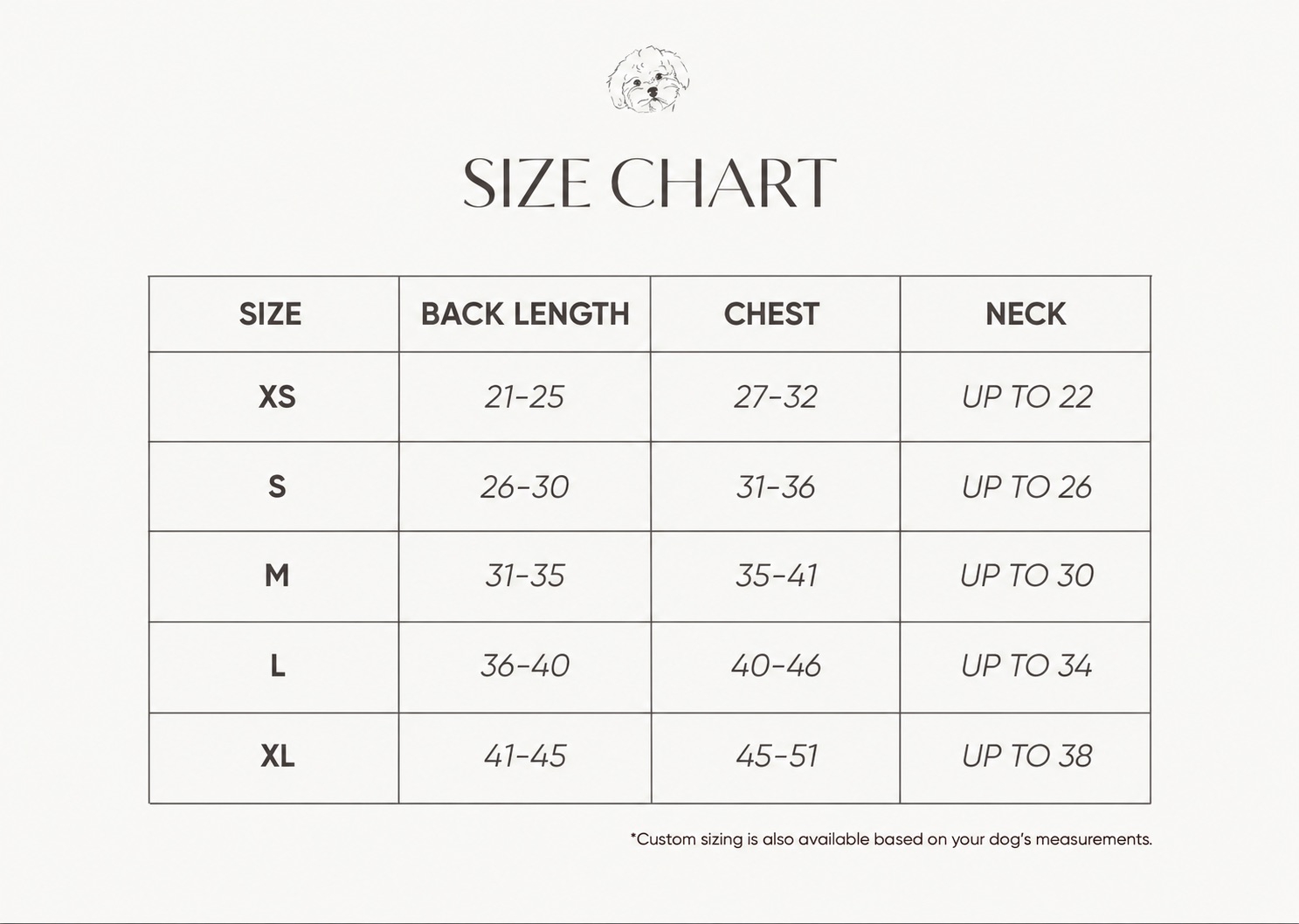
At Feel with Fill, a size is decided by two measurements — chest girth and back length. There is no weight column in our chart, and that is not a simplification: two dogs of identical weight can have very different chests, and clothes fit by girth, not by the scales. The standard chart runs from a 27 cm chest to a 51 cm one — sizes XS to XL — and a miniature pinscher almost always lands in the middle of it. The full chart, in centimetres and inches, is on the size guide page.
Here is how the breed's approximate measurements map onto our chart:
- S — back 26–30 cm (10.2–11.8 in), chest 31–36 cm (12.2–14.2 in). Suits small, very dry min pins, more often females and young dogs that have just finished growing.
- M — back 31–35 cm (12.2–13.8 in), chest 35–41 cm (13.8–16.1 in). Usually the right row for an adult dog of average proportions: both measurements sit comfortably in it.
- L — back 36–40 cm (14.2–15.7 in), chest 40–46 cm (15.7–18.1 in). This size is taken by the chest — for males at the top of the standard and for dogs with a deep, well-developed ribcage. A 36–40 cm back, though, is usually too long for a min pin, so compare both measurements before you order.
The chest girth is the measurement that decides whether a piece will pinch under the arms and across the ribcage. If chest and back fall in the same row of the chart, order that size with confidence. If they stretch across two rows — chest like an L but back like an S or M — a ready-made piece will fit less well: taken by the chest, it bunches over the croup and creeps under the tail; taken by the back, it pulls across the chest. In that case a custom size is the safer answer: +15% on the model price, 3–6 business days to make. If you already know the size, it is quicker to start from our clothes by size selection.
The miniature pinscher is not in our size-by-breed table, which lists the breeds we have real order statistics for. The ranges above are therefore derived from the breed standard and marked as approximate: they tell you which size to start from, but they do not replace measuring your own dog.
How to measure a miniature pinscher
Take a soft tape measure and have the dog stand square on all four legs on a non-slip surface — not sitting, not lying down. A min pin rarely stands still, so measure after a walk, once the dog has run itself out, and ideally with four hands: one person holds a treat, the other takes the numbers.
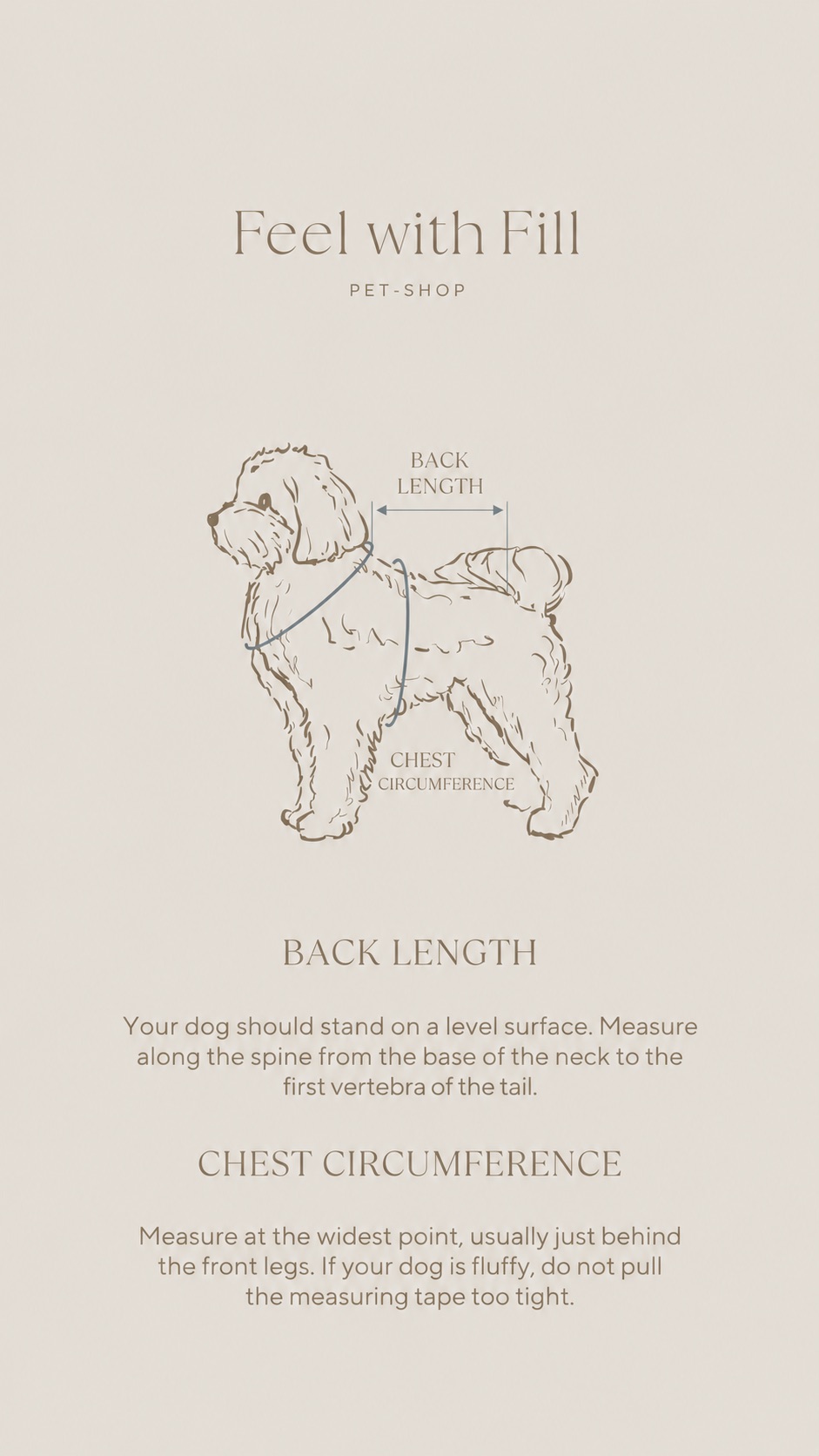
- Chest girth — around the widest part of the ribcage, just behind the front legs. A min pin's chest is deep, so the tape has to pass through the deepest point rather than higher up over the shoulder blades. Do not pull it tight: a finger should slide under the tape easily.
- Back length — from the base of the neck, where the neck meets the spine, to the base of the tail. Height at the withers is not needed to pick a size; the withers are simply where this measurement starts.
- Neck girth — at the base of the neck, where a collar normally sits. A min pin's neck is long and dry, so a neckline chosen by eye often turns out too loose — and a loose collar lets the wind straight in.
Write all three numbers down and compare them with the chart. Min pins hold their shape for years, so there is no need to re-measure every season — but after winter, when the dog has moved less, check the chest again.
Why a miniature pinscher feels the cold before other small breeds
A min pin has no undercoat — the soft lower layer that works like woollen underwear on a pomeranian or a yorkie and keeps a cushion of warm air against the skin. The guard coat of a miniature pinscher is short, sleek and flat to the body: it sheds water well and hardly picks up dirt, but it barely insulates. That is why the dog starts looking for warmth when it is merely cool outside.
The second reason is proportion. A min pin is small, and in small dogs the ratio of body surface to body volume is higher than in large ones, so heat leaves that body faster. Add long, dry legs and thin skin with no fat reserve, and it is clear why a min pin shivers in autumn on the same walk where a labrador has not yet noticed the weather.
In practice this means a light layer is already useful at around +10…+12 °C (50–54 °F) once wind or drizzle is added — not only when the frost arrives. The signs of a cold dog are easy to read in this breed: shivering, a hunched back, a tucked belly, one paw lifted, the dog pulling for home or asking to be carried. Rather than waiting for them, put on a light vest or anorak in advance. We go into who needs clothes and in what weather in our guide on whether your dog needs clothes.
There is a flip side. A miniature pinscher is a very busy dog that barely stands still on a walk. An insulated jumpsuit at +8 °C (46 °F) on an active walk is too much — the dog gets damp underneath and then chills faster at the first stop. So for autumn it is better to keep two layers to choose from: a light one for movement and a warm one for slow walks and frost.
A min pin's build: deep chest, narrow waist, long legs
The standard describes the miniature pinscher as square in build: body length roughly equals height at the withers. For clothes, three practical consequences follow.
- A deep chest on a short back. The ribcage drops low, almost to elbow level, while the body itself is short. So the chest girth pulls the size up and the back length pulls it down. This is where the need for a custom size most often comes from.
- A narrow waist. The belly line is tucked up, so a piece chosen by the chest often sits loose at the waist. For a vest or a coat that is no problem, but a jumpsuit without adjustment can slide around the sides. Elasticated drawstrings solve it — the fleece jumpsuit has them, and they let you fit the piece precisely to the dog.
- Long legs and a high stance. A min pin stands tall on its legs and has a characteristically high, lifting step. A jumpsuit bought with room to grow tangles in the legs and breaks that stride, so leave no spare length at all. For a vest or an anorak, though, long legs are an advantage: they stay completely free.
There is a fourth point that gets mentioned far less often: a short coat forgives nothing. On long hair a seam or a raw edge disappears; on a min pin's smooth skin it rubs. So with this breed the inside of a garment matters. The “Hugme” hoodie has a natural lining inside the hood and sleeves that hides the seams and stops claws catching as you put it on; the fleece vest has a viscose lining that does not mat the coat; and on the fleece anorak the zip is bound with trim so it cannot catch hair.
What a miniature pinscher should wear in different weather
Below is a working guide for a short-coated dog with no undercoat. The temperatures assume a calm walk; wind, rain and damp shift the whole scale about one step towards warmer pieces.
- +12…+16 °C (54–61 °F), dry. Not every dog needs anything. If your min pin shivers or is reluctant to go out, a knitted layer is enough: the “Charmie” turtleneck or the “Waffle” longsleeve.
- +5…+12 °C (41–54 °F), wind and drizzle. The fleece anorak — a light outer layer with a water-resistant finish that does not restrict movement. For an active walk, the fleece vest is the alternative: it warms the back and chest and leaves the legs free.
- Rain. The “Brooklyn Jacket” in water-repellent raincoat fabric with a viscose lining, or the “Vivienne” vest if you want a shorter layer.
- Slush, wet snow, de-icing salt on the pavements. The “Heaven” jumpsuit — water-repellent, covering back, belly and legs, with a detachable hood and a hidden harness opening.
- 0 to −10 °C (32 to 14 °F), dry. The “Puffy” puffer vest in waterproof fabric with insulation, or the fleece-lined “Gossip-coat” with its fur collar.
- Below −10 °C (14 °F), wind. The “Gossip-puffer” jumpsuit — an insulated puffer for frost and snow, for when a hoodie or a light vest is no longer enough. Or the fleece jumpsuit plus a shorter walk.
- After the walk and a paw wash. A drying robe in 100% cotton terry soaks up the water while the coat dries, so the dog does not sit around getting cold in damp hair.
The temperature scale for all breeds is collected in our guide to winter dog clothes.
Autumn clothes for a miniature pinscher
Autumn is hard on this breed precisely because of the swings. Morning at +4 °C (39 °F), afternoon at +14 °C (57 °F), evening cold and damp again — a dog with no undercoat reacts to every one of those swings. So build a min pin's autumn kit as layers rather than one “does-everything” piece.
The base layer is knitwear. The “Charmie” turtleneck costs $27: soft knit with a fine pattern that warms the neck and the back. With this breed that matters — a min pin's long, dry neck loses heat quickly, and the turtleneck covers it completely. The “Waffle” longsleeve at $25 is the option without a high collar, for dogs that dislike anything closing around the neck. Both work as indoor clothes in a cool flat and as a base under a vest.
The second layer is what goes on top. The fleece anorak at $35 holds heat thanks to the air trapped in the fabric and has a water-resistant finish, so it copes with wind and light rain. The fleece vest at $38 answers a different need: it warms the body and has a harness opening, which is more practical than a collar for a min pin, since most are walked in a harness. If your autumn is a wet one, look at raincoat fabric instead: the “Vivienne” vest at $45 or the “Brooklyn Jacket” at $52, with corduroy inserts and a collar opening for the lead.
The third layer appears in November, when the slush starts. Now a jumpsuit is needed, one that covers the belly and legs: “Heaven” at $71 is water-repellent and handles mud and wet snow. Every model in this paragraph is made in sizes XS–XL, that is for a chest of 27–51 cm (10.6–20.1 in), and any of them can be ordered to your dog's measurements.
Winter jumpsuits and vests for a miniature pinscher
In winter a short-coated dog faces two problems — frost and road salt. Frost takes heat away faster than it would from a breed with an undercoat, and the salt and chemicals on pavements irritate the belly skin, which on a min pin is barely covered by coat and sits low to the ground. A jumpsuit answers both.
The fleece jumpsuit at $52 is the basic frost option: polar fleece holds heat and keeps moisture out, the zip runs along the back so it goes on quickly, and a hidden hook-and-loop tab adjusts the neckline. For a dog with a dry neck that is a direct gain — you can close the neckline tighter so the wind cannot get in. Elasticated drawstrings fit the body, which helps with this breed's narrow waist.
The “Gossip-puffer” at $79 is an insulated puffer jumpsuit for real frost and snow, for when a hoodie or a light vest is no longer enough. “Heaven” at $71 is the one to pick when the problem is not temperature but water: it is water-repellent, with a detachable hood and a hidden harness opening.
A vest makes sense in winter too, and not only as a lighter alternative. A min pin moves a lot and moves sharply; in a jumpsuit on an active walk in dry frost it can overheat, while a vest warms the body and leaves the legs and armpits free. “Puffy” at $46 is made of waterproof fabric with insulation, fastens with snaps and has a harness opening. The “Gossip-coat” at $66 suits owners who would rather not pull anything over the dog's head: it goes on from above, with a fur collar against the wind, a harness opening and an adjustable strap. There is more to choose from in vests, coats, jackets and jumpsuits.
Turtleneck, longsleeve or hoodie for indoors and mid-season
A short-coated dog with no undercoat is often cold indoors as well — especially before the heating comes on, and in older buildings with cold floors. A min pin in those conditions burrows under blankets and sleeps curled in a tight ball. A soft knitted layer solves that more simply than a heater.
The “Charmie” turtleneck hugs the body, warms the neck and back, and works both as a standalone indoor piece and as a base under a vest for walks. The “Waffle” longsleeve is a lighter cut that does not restrict movement; it also works indoors and under an outer layer. Both are in the jumpers and turtlenecks section.
A hoodie is warmer than knitwear and already works outdoors on a cool day — all the models are in the dog hoodies section. “Hugme” at $38 has a brushed inner face that holds warmth, plus the natural lining in the hood and sleeves that hides the seams and keeps claws from catching. “Teddy” at $38 is made of plush fabric, and its hood buttons on, so it is easy to remove when the dog walks in a harness. For a min pin that is still getting used to clothes, a hoodie is often the first piece: it goes on over the head, has little hardware and leaves the legs alone.
Six models for a miniature pinscher, with prices
An autumn and winter selection for a short-coated dog. The prices are for standard sizes; every model here is made in XS–XL and to measure.
- Beige dog turtleneck “Charmie” — $27. A knitted base layer that warms the neck and back.
- Anthracite fleece dog anorak — $35. A light outer layer with a water-resistant finish, for autumn and spring.
- Anthracite fleece dog vest — $38. Viscose lining, harness opening, legs completely free.
- Light-blue dog puffer vest “Puffy” — $46. Waterproof fabric with insulation, snap fastening, harness opening.
- Khaki fleece dog jumpsuit — $52. Zip along the back, adjustable neckline, drawstrings along the body.
- Brown polka-dot dog jumpsuit “Heaven” — $71. Water-repellent, detachable hood, hidden harness opening.
A custom size adds 15% to the model price, and we round the surcharge up. For this selection that works out as: fleece anorak $41, fleece vest $44, “Puffy” vest $53, fleece jumpsuit $60. For any other model, the manager will confirm the exact made-to-measure price when you place the order. Everything we can sew to measurements is gathered on the custom dog clothes page.
When to order made-to-measure for a min pin
Most miniature pinschers fit a ready-made size — the breed sits inside our chart. A custom size is worth choosing if:
- chest girth and back length fall in different rows of the chart — for example a 42 cm chest, which is an L, with a 31 cm back, which is an M;
- the chest is deep and well developed while the waist is very narrow, so a ready-made piece is tight across the chest and loose at the waist at the same time;
- you need a closer neckline for that long, dry neck so the wind cannot get in;
- when you try a ready-made piece it pinches under the arms, slides to one side or bunches over the croup;
- the chest girth falls outside 27–51 cm (10.6–20.1 in) — rare in this breed, but it happens with very small dogs.
How to order: choose “Custom size” on the product page and place the order — the manager will contact you to confirm the measurements. Production takes 3–6 business days from payment. Please note that made-to-measure items and items in a non-standard colour cannot be exchanged or returned, so take the measurements carefully; if you are unsure, start with a ready-made size and see how it sits.
Looking after a min pin's clothes
A short coat leaves almost no hair on the fabric, so a min pin's clothes get dirty mainly from below — along the belly and legs. Hence a few practical notes.
- Wash by colour. We recommend washing dark pieces separately before the first wear so the colour stays deep. Light pieces go in separately from dark ones at 30 °C (86 °F).
- Practical colours. Anthracite, khaki and brown show autumn mud less. Milk white and beige photograph more prettily but need washing more often.
- Terry works better after a wash. Wash the drying robe before its first use: the terry absorbs water better afterwards.
- Two sets for the slushy season. If you walk twice a day, one piece does not always dry in time — keep a light layer and an outer one to alternate.
- Hardware. Close zips and snaps before washing — they last longer and will not catch the fabric.
Clothes for a miniature pinscher puppy
A min pin finishes growing at roughly 9–12 months and grows fastest in the first months. In that time a puppy can move through several sizes of our chart — from XS up to M or L. So buy a ready-made size by today's measurements, with no room to grow: an oversized piece slides sideways, tangles in the legs and teaches the dog that clothes are uncomfortable. Check the chest girth every two or three weeks.
Leave made-to-measure until later: before the dog has finished growing, a custom piece will be outgrown, and it cannot be returned. Start indoors and for a few minutes at a time — put on a light hoodie, praise the dog, give a treat and take it off while the puppy is still calm. There is more detail in our puppy clothes guide.
How to order and receive your order
We sew in our own Feel with Fill workshop in Kyiv; the brand has been running since March 2023. Production takes 3–6 business days from payment; if the model you want is in stock in the right size, it can ship sooner — ask the manager about availability. Payment is by card, Apple Pay or Google Pay via monobank, or cash on delivery with a UAH 300 prepayment.
Within Ukraine, delivery is free from UAH 4,000 (after discount) and otherwise charged at the carrier's rates; shipping abroad is arranged with the manager and usually takes 1–2 weeks. The conditions are collected on the shipping and payment page. A standard-size item can be exchanged or returned within 14 days of delivery: the buyer pays return postage, and we pay if the item is faulty or the wrong one was sent. Made-to-measure items and items in a non-standard colour cannot be exchanged or returned. Details on the exchange and returns page.
Frequently asked questions
What size clothes does a miniature pinscher wear?
Approximately a 36–46 cm (14.2–18.1 in) chest girth and a 26–33 cm (10.2–13 in) back length, which most often means size M, less often S or L. These figures come from the breed standard, so measure your own dog before ordering: the chest girth is the key measurement, and it is what decides the size within our XS–XL chart (27–51 cm / 10.6–20.1 in).
Does a miniature pinscher need clothes in autumn?
Yes, and this is the main way the breed differs from a pomeranian or a yorkie. A min pin has no undercoat, so a light layer is already useful at around +10…+12 °C (50–54 °F) once wind or drizzle is added. A fleece anorak or a fleece vest is enough for that weather; save the insulated pieces for frost.
What should a miniature pinscher wear in frost?
In dry frost down to −10 °C (14 °F), the “Puffy” puffer vest or the fleece-lined “Gossip-coat” works well. Below −10 °C and in wind you need a jumpsuit that covers the belly and legs: the insulated “Gossip-puffer” or the fleece jumpsuit with its adjustable neckline. For slush, choose the water-repellent “Heaven”.
Why is there no dog weight in your size chart?
Because weight does not tell you how a piece will fit. Two dogs of the same weight can have different chests, depending on ribcage depth, body length and how much coat they carry. Our chart is built on chest girth (27–51 cm / 10.6–20.1 in) and back length, and those two measurements are all that is needed. Height at the withers is not needed either — it only marks the point where the back measurement starts.
How much do made-to-measure miniature pinscher clothes cost?
15% more than the standard size, with the surcharge rounded up. A made-to-measure fleece anorak is $41, the fleece vest $44, the “Puffy” vest $53 and the fleece jumpsuit $60. Production takes 3–6 business days from payment.
Will a miniature pinscher overheat in a jumpsuit?
It can, if the insulated piece goes on when the weather does not call for it. A min pin barely stops moving on a walk, so at +8 °C (46 °F) it is happier in an anorak or a vest, and the jumpsuit is better saved for frost and slush. Indoors, take a warm piece off straight away: on transport, in a shop or in a heated stairwell, a dog in a jumpsuit gets hot quickly.
Similar breeds: toy terrier clothes · chihuahua clothes · Jack Russell clothes · dachshund clothes · dog clothes size by breed