Fleece dog clothes: anoraks, vests and jumpsuits
In short: fleece dog clothes are a light warm layer — the air trapped in the fleece holds the heat, the fabric itself barely weighs anything and never restricts movement, and fleece dries quickly after a wash. Feel with Fill makes 25 fleece pieces: 8 anoraks with a water-repellent finish ($35), 8 fleece vests lined with natural viscose ($38), 7 polar fleece jumpsuits ($52) and 2 fleece-lined “Gossip-coat” coats ($66). A fleece vest already helps on windy 50…41 °F (+10…+5 °C) days, fleece works as the single warm layer at 41…32 °F (+5…0 °C), and a fleece jumpsuit covers the range down to 14 °F (−10 °C). Sizes XS–XL (chest 27–51 cm / 10.6–20 in) or made to your dog’s own measurements.
Why fleece keeps a dog warm, and which dogs need it
Fleece is a brushed synthetic fabric where the warmth comes less from the fibre itself than from the air held between the raised strands. That is why a fleece piece warms better than it looks: it is thin and light, it does not restrict movement and it does not stop a dog from running. The second advantage is that fleece does not soak up water the way cotton does — it still warms when damp and dries quickly after a wash or a spell of drizzle. That is how fleece became the standard fabric for the in-between seasons: it is used both as a light outer layer and as a warm lining.
Fleece clothes matter most to the same dogs that need clothes at all: small breeds, short-haired dogs and dogs without an undercoat, groomed dogs, puppies and senior dogs. Dogs with a thick double coat — huskies, malamutes, samoyeds, shepherds — usually do not need a warm layer at all and overheat in one. Our guide “Does my dog need clothes: which dogs and in what weather” goes through this in detail.
What temperature fleece dog clothes are for
The table below brings every fleece piece together and matches it to the weather, in line with our guides “Winter dog clothes” and “Does my dog need clothes”. Treat it as a guide for small, short-haired and freshly groomed dogs.
| Weather | Which fleece piece works | Where to choose |
|---|---|---|
| 50…41 °F (+10…+5 °C), windy | a fleece vest as a light layer | vests |
| 41…32 °F (+5…0 °C), dry | one warm layer: a fleece vest or a fleece anorak | vests, anoraks |
| 41…32 °F (+5…0 °C), cool and damp | a fleece jumpsuit — it also covers the belly and legs | jumpsuits |
| 32…23 °F (0…−5 °C) | the fleece-lined “Gossip-coat”; a fleece vest works as insulation under a jacket | coats, vests |
| 23…14 °F (−5…−10 °C) | a fleece jumpsuit that covers the belly and legs | jumpsuits |
| below 14 °F (−10 °C) | fleece alone is not enough: use the padded “Gossip-puffer” and add fleece as a layer underneath | jumpsuits |
| Drizzle and light rain | a fleece anorak — it has a water-repellent finish | anoraks |
| Downpours, slush, wet snow | not fleece: this calls for the water-repellent membrane “Heaven” jumpsuit | jumpsuits |
Wind and damp take heat away faster than dry frost, so at 23 °F (−5 °C) with wind, read the “23…14 °F (−5…−10 °C)” row instead. Layers beat one thick garment — two thin layers warm better and leave the dog free to move, which is why a fleece vest is worn on its own in autumn and under a jacket in winter. If you plan to wear fleece underneath, allow 2–3 cm (about an inch) extra chest girth on the outer piece.
The fleece pieces at Feel with Fill
| Category | Colours | Price | Role of the fleece |
|---|---|---|---|
| Fleece anoraks | 8 | $35 | main fabric plus a water-repellent finish |
| Fleece vests | 8 | $38 | main fabric, lined with natural viscose |
| Polar fleece jumpsuits | 7 | $52 | main fabric |
| Fleece-lined “Gossip-coat” coats | 2 | $66 | fleece as the lining, with a fur collar on top |
That is 25 fleece pieces in all. In 23 of them fleece is the main fabric (anoraks, vests, jumpsuits); in the two “Gossip-coat” coats fleece is the lining. Every model comes in sizes XS–XL (chest 27–51 cm / 10.6–20 in) or made to your dog’s measurements (+15%), handmade in our own workshop in 3–6 business days.


Fleece anoraks: a light outer layer for autumn and spring
The anorak is the lightest fleece piece in the collection. The air layer in the fabric holds the heat, the light fleece structure does not weigh the dog down and allows natural movement, and the water-repellent finish protects from bad weather. The binding around the zip keeps the coat from catching. An anorak handles drizzle and light rain; for downpours and slush the water-repellent “Heaven” jumpsuit is the better choice. The difference from a hoodie: a hoodie is knitwear and does not keep moisture out, while a fleece anorak with its water-repellent finish suits cool, wet weather outdoors.
Eight colours at $35 each: anthracite, light-blue, burgundy, khaki, brown, milk-white, pink, taupe. All of them are in the anoraks and raincoats category.
Fleece vests: a layer to wear on its own or under a jacket
A vest covers the back and chest and leaves the legs free — comfortable between seasons and ideal for active dogs. The Feel with Fill fleece vest is made of quality fleece, lined with natural viscose that prevents matting, fitted with a harness opening and finished with premium hardware. In autumn it is worn as the single warm layer; in winter it goes under a jacket as insulation.
Eight colours at $38 each: anthracite, light-blue, burgundy, khaki, brown, milk-white, pink, taupe. All of them are in the vests category.
Polar fleece jumpsuits: warmth on the back, belly and legs
A jumpsuit gives the most protection: it covers the back, the belly and all four legs, so snow and mud stay off the coat. The polar fleece jumpsuit holds the heat reliably and protects even in cool, damp weather; the zip along the back makes dressing easier, the hidden hook-and-loop fastening adjusts the neckline and keeps the coat from catching, and elastic drawstrings fine-tune the fit. A fleece jumpsuit is at its best in cool, damp weather without heavy rain — for downpours and slush choose the membrane “Heaven”.
Seven colours at $52 each: light-blue, burgundy, khaki, brown, milk-white, pink, taupe. All of them are in the jumpsuits category.
Fleece-lined “Gossip-coat”: warmth without legs
In a coat the fleece is the lining: the piece itself is warm, with a fur collar that blocks the wind, a harness opening and an adjustable strap for a precise fit. A coat has no legs and goes on in a few seconds, which suits dogs that will not tolerate a jumpsuit and short trips outside. In the temperature table of our winter guide the “Gossip-coat” sits in the 32…23 °F (0…−5 °C) row.
Two colours at $66 each — the light-blue and the tash “Gossip-coat”. Both are in the coats category.
Choosing the size
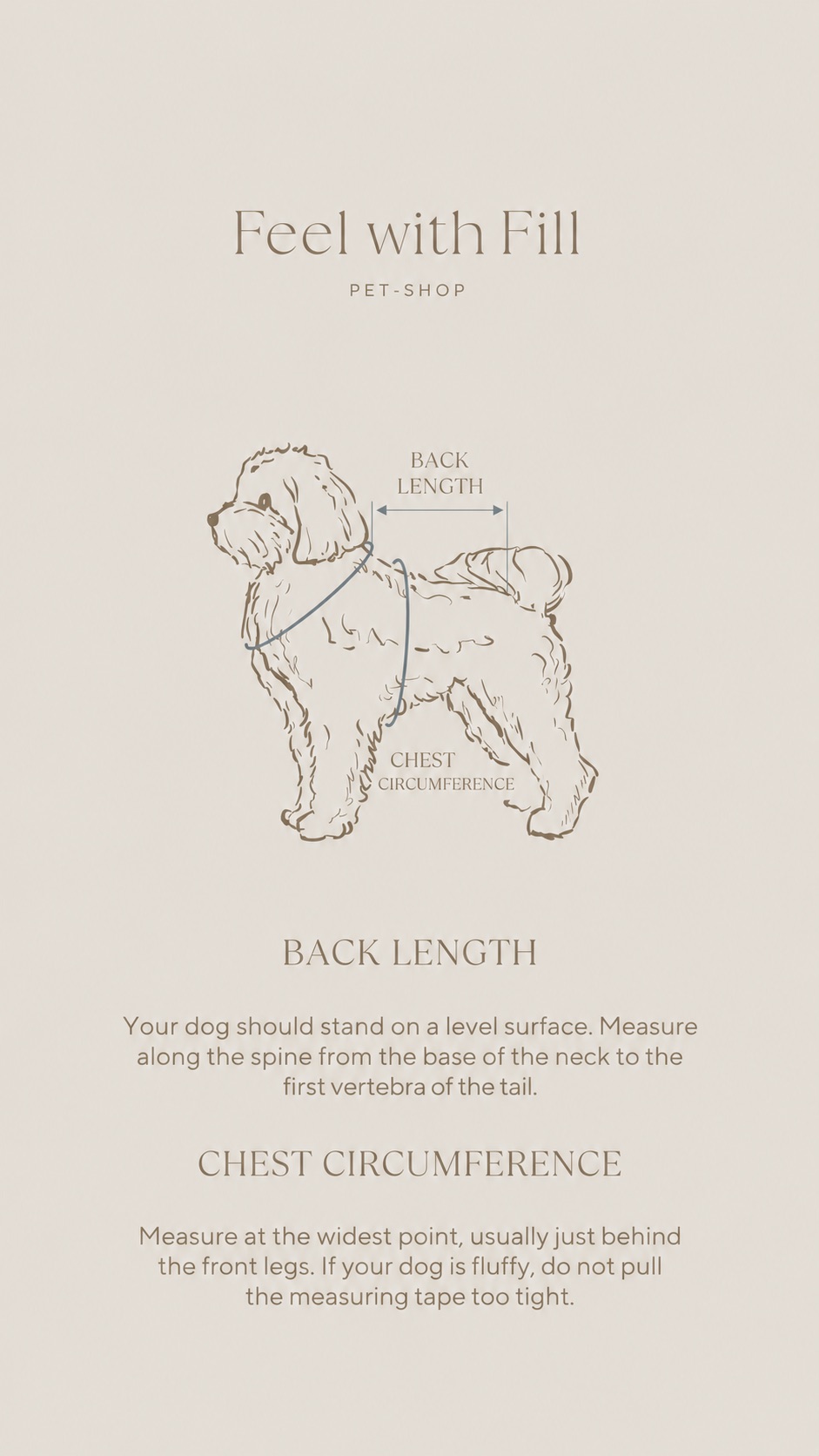
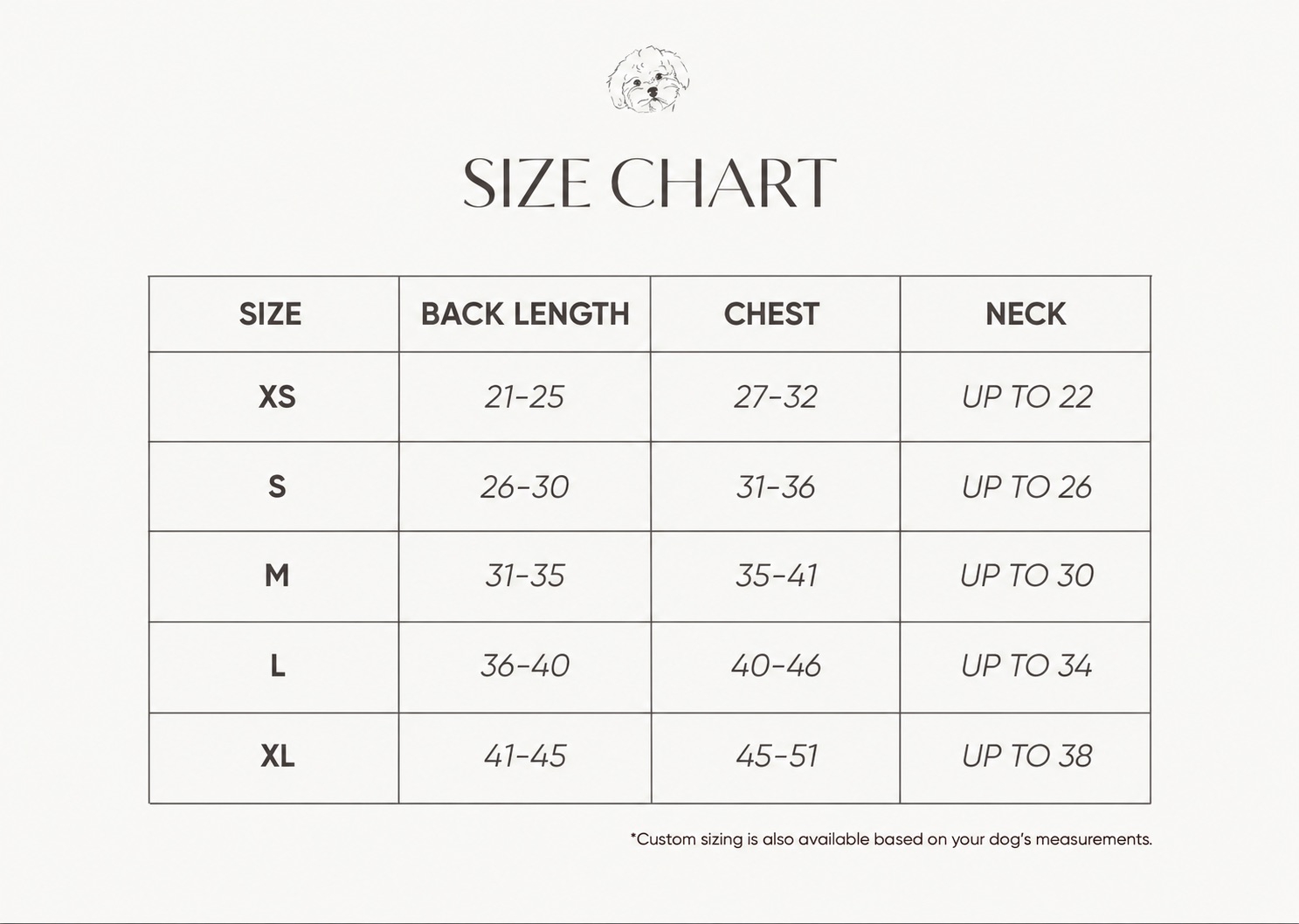
Chest girth decides the size — it is the measurement that matters most. Measure your dog standing, with a soft tape: chest girth at the widest point just behind the front legs, back length from the base of the neck to the start of the tail, neck where the dog wears a collar. Do not pull the tape tight and do not press the fur flat.
| Size | Back length | Chest girth | Neck girth |
|---|---|---|---|
| XS | 21–25 cm (8.3–9.8 in) | 27–32 cm (10.6–12.6 in) | up to 22 cm (8.7 in) |
| S | 26–30 cm (10.2–11.8 in) | 31–36 cm (12.2–14.2 in) | up to 26 cm (10.2 in) |
| M | 31–35 cm (12.2–13.8 in) | 35–41 cm (13.8–16.1 in) | up to 30 cm (11.8 in) |
| L | 36–40 cm (14.2–15.7 in) | 40–46 cm (15.7–18.1 in) | up to 34 cm (13.4 in) |
| XL | 41–45 cm (16.1–17.7 in) | 45–51 cm (17.7–20 in) | up to 38 cm (15 in) |
If the chest is under 27 cm (10.6 in) or over 51 cm (20 in), or if the measurements do not fall into one size (an S chest with an XS back, for instance), choose “Custom size”: any fleece model can be made to your dog’s measurements (+15%). When fleece goes under an outer layer, allow 2–3 cm (about an inch) extra chest girth on that outer piece. Step-by-step instructions and the full tables are on our size guide.
How to wash fleece dog clothes, and what to do about pilling
Wash fleece on a delicate cycle up to 30 °C (86 °F) and without fabric softener — softener spoils the fleece. Dry it naturally and flat, not on a radiator; a tumble dryer is not for fleece, as the heat can make it lose its properties or shrink. Wash light items separately from dark ones, and wash dark items on their own before the first wear so the colour stays rich. Care notes for every fabric we use are in our guide “How to wash and care for dog clothes”.
Pilling is simply what brushed fabrics do: the little bobbles appear wherever the fleece rubs constantly, most often under a harness and along the sides. You cannot avoid it entirely, but a delicate wash without softener and drying without heat slow it down, and a fabric shaver removes the bobbles themselves. Matting in your dog’s own coat is a different matter: the fleece vest is lined with natural viscose to prevent it, and the main rule is not to buy a tight size, because it is the constant rubbing of clothes that are too snug that tangles and mats the coat.
Buying fleece dog clothes
Feel with Fill is a Ukrainian dog clothing brand founded in 2023: we draft our own patterns and sew everything in our own workshop in Kyiv. Fleece models come in sizes XS–XL (chest 27–51 cm / 10.6–20 in), and dogs with unusual proportions can have any model made to measure (+15%). Pieces are made in 3–6 business days, sooner if the size you need is already in stock. For international orders our manager will contact you in English to confirm the shipping cost and the payment method. Standard-size items can be exchanged or returned within 14 days of receipt; made-to-measure items and items in a non-standard colour cannot.
Frequently asked questions
Does fleece get wet?
Fleece does not soak up water the way cotton does: it still warms when damp and it dries quickly. Feel with Fill anoraks also have a water-repellent finish, so they handle drizzle and light rain. Fleece is not waterproof, though — for downpours, slush and wet snow the water-repellent membrane “Heaven” jumpsuit is the safer choice.
Which is warmer, a fleece vest or a fleece jumpsuit?
The jumpsuit: it covers the back, the belly and the legs, while a vest covers only the back and chest. In the table in our winter guide the fleece vest and the fleece anorak sit in the +5…0 °C row, and the fleece jumpsuit in the −5…−10 °C row.
From what temperature should a dog wear fleece?
A fleece vest already helps at 50…41 °F (+10…+5 °C) in the wind, fleece works as the single warm layer at 41…32 °F (+5…0 °C), and a fleece jumpsuit covers the range down to 14 °F (−10 °C). Below that, fleece alone is not enough — use a padded jumpsuit and keep the walk to 10–15 minutes.
Can fleece dog clothes go in the washing machine?
Yes: a delicate cycle up to 30 °C (86 °F), without fabric softener, which spoils the fleece. Dry naturally and flat, away from radiators and out of the tumble dryer.
Is there fleece clothing for small and for large dogs?
The smallest ready size is XS: chest 27–32 cm (10.6–12.6 in), back 21–25 cm (8.3–9.8 in). The largest is XL: chest 45–51 cm (17.7–20 in). For dogs smaller than XS or bigger than XL, any fleece model can be made to your dog’s own measurements (+15%).
Will fleece clothes mat my dog’s coat?
The fleece vest is lined with natural viscose, which prevents matting. With long-coated dogs the main rule is not to buy a tight size: it is the constant rubbing of clothes that are too snug that tangles and mats the coat.
Read next: does my dog need clothes · winter dog clothes · size guide · how to wash dog clothes · anoraks · vests · jumpsuits · coats